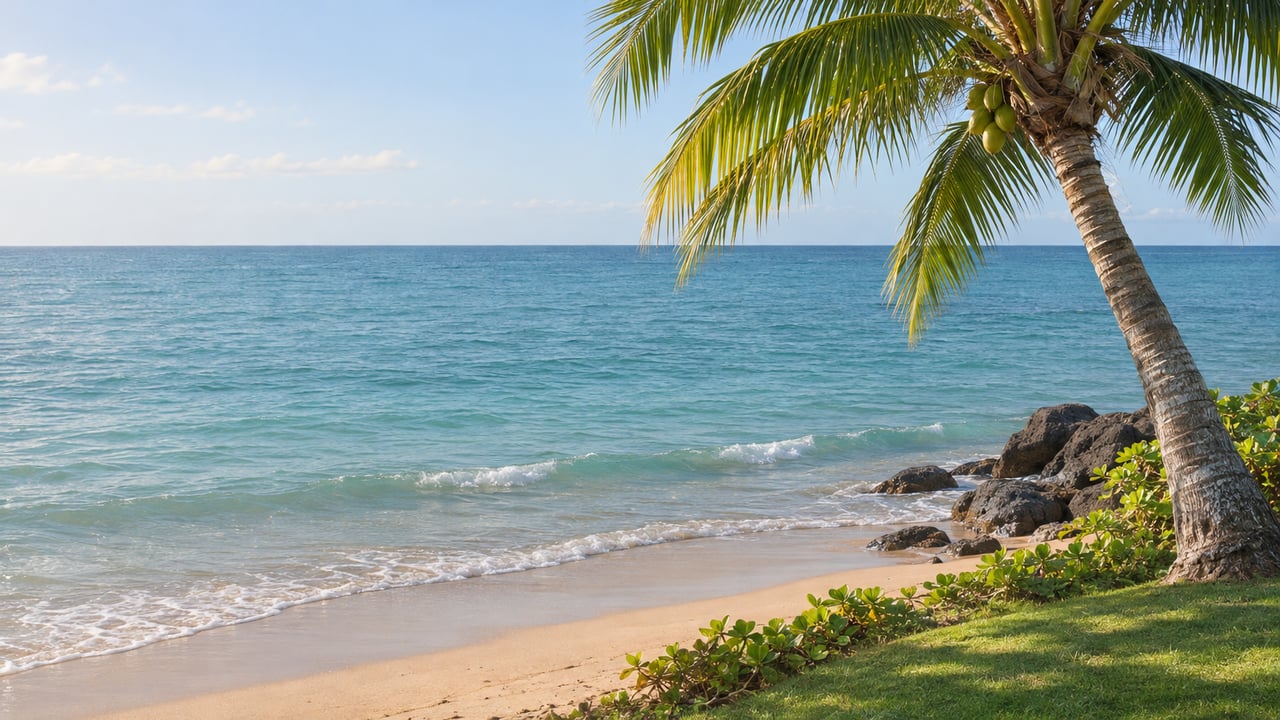
At the paved lots of Kamaʻole Beach Parks I and III, a Kihei address no longer decides whether you park free. The barcode on the back of a Hawaiʻi driver's license decides. If you scan one, you park free all day. Without one, you pay $10 a day, whether you flew in last Tuesday or have owned a condo on South Kihei Road for twenty years. Seasonal residents start arriving for winter around now, and for many of them this will be their first time at Kamaʻole under Park Maui. The program went live on July 15, 2026, in the middle of what is usually the off-season for part-time owners.
The test is a scan, and it runs on your plate
Park Maui is the County of Maui Department of Transportation's parking management program. According to the County's July 9 launch release, kamaʻāina park free seven days a week by scanning the barcode on the back of a valid Hawaiʻi driver's license at a pay station or in the Park Maui mobile app.
There is no paper ticket. The system is plate-based, so each parking session is tied digitally to the license plate of the car you parked. Parking Ambassadors work on site to answer questions and show drivers how to use the app and the pay stations. If the app asks for a zone, the Kamaʻole lots are Zone 797.
In practice, the scan is the step that matters. A resident who pulls in and heads to the sand without scanning hasn't started a free session, so the plate has no session attached to it. When the County Council took up the program in 2025, Maui Now reported that ambassadors would enforce the rules after a grace period and that violators could face citations or impoundment.
The ambassadors are on-site staff, and their schedule can change. During Tropical Storm Lala in August, Maui Now's County update said staffing and active enforcement at Kamaʻole I and III were suspended at 4 p.m. on Aug. 15, with staff due back on Aug. 17.
Two lots, very different odds
The license rule applies the same way at both Park Maui lots in Kihei, but the lots themselves are very different in size. Park Maui's beach page lists them this way:
| Kamaʻole I | Kamaʻole III | |
|---|---|---|
| Address | 2400 South Kihei Road | 2800 South Kihei Road |
| Lot hours | 7 a.m. to 8 p.m. | 7 a.m. to 8 p.m. |
| Parking | 18 spaces, plus 4 ADA and 4 reserved lifeguard spaces | 84 spaces |
| Park size | 3 acres | 10 acres |
| Usually busy | 8 a.m. and 11 a.m. to noon | 8 a.m. and 11 a.m. to noon |
| Facilities | 1 comfort station, 3 outdoor showers, 4 picnic tables, 3 grills, sand volleyball court | 1 comfort station, 2 portable toilets, 3 outdoor showers, 22 picnic tables, 8 grills, swing set |
Kamaʻole III has more than four times as many general spaces as Kamaʻole I. With only 18 general spaces at Kamaʻole I, a handful of early cars can fill the lot. Park Maui's page notes additional parking across the street from Kamaʻole I.
On weekends and County-observed holidays, both paved lots are reserved for residents only until 10 a.m. Park Maui lists 8 a.m. as one of the usually busy times at both beaches, so the morning rush falls entirely inside the window. The late-morning peak from 11 a.m. to noon comes after the lots open to everyone.
From Saturday, Nov. 21, through the last weekend of December, that adds up to twelve weekend mornings under the resident-only rule, plus any County-observed holidays in between. On each of those mornings, the first three hours at the paved Kamaʻole I and III lots belong to Hawaiʻi license holders, starting when the lots open at 7 a.m.
The beach itself is open to everyone at all times. The County release says the beach parks remain open to all; the restriction applies only to the paved parking.
What part-time owners pay
Park Maui sorts drivers into two groups. Hawaiʻi residents with a valid Hawaiʻi driver's license park free. "Part-time residents and visitors" share one rate card, paid at a pay station or in the app.
- Daily: $10
- Weekly: $50, valid for 7 consecutive days
- Monthly: $150, valid for 30 consecutive days
Weekly and monthly passes are sold only through the Park Maui mobile app and the Park Mobile website. Park Maui says a pass covers its beach and park locations within a region, using South Maui as the example.
For a seasonal owner, the comparison is simple. A weekly pass costs the same as five daily payments, so it pays off if you'll park on five or more of those seven days. A monthly pass costs the same as fifteen daily payments, so it pays off at fifteen beach days in a 30-day stretch. For someone who walks to Kamaʻole most days, parking is beside the point. For someone who drives down from the upper part of Kihei or from Maui Meadows for a swim almost every morning, four back-to-back monthly passes cost $600 and cover about 120 days, which is roughly December through March.
The pass covers the fee. It does not change the hours. On weekends and County-observed holidays, the paved lots are reserved for residents before 10 a.m., and a monthly pass doesn't make a non-Hawaiʻi-license driver a resident under the program. When the Council first approved the measure, Maui Now described the rule as non-residents being able to park only after 10 a.m. on weekends and holidays.
This is general information, not legal or financial advice. If you're unsure how the rules apply to your own license or vehicle, check directly with Park Maui or the County.
The lots outside the program, and why that may change
Not every Kamaʻole parking space was included at launch. Kamaʻole II was left out of the July 15 rollout while the County repaired damage from the March Kona low storms. The dirt lot across from Kamaʻole I, next to the ABC Store, was also left out. At launch, that dirt lot was free from 7 a.m. to 8 p.m. daily, both for beachgoers and for employees and customers of businesses along South Kihei Road near the Kamaʻole shopping district.
The County's release said the dirt lot would be added to Park Maui once the South Kihei Road sinkhole repair was finished and the road reopened. The Maui News reported that Kamaʻole Beach Park II and the adjacent road reopened Aug. 11, with parts of the park still barricaded for hydromulching.
The condition the County set for adding the dirt lot has now been met. If you've been using it as the free fallback next to Kamaʻole I, check the map on Park Maui's beach page for the lot's current status before you assume it's still free.
Park Maui's beach page says kamaʻāina park free "at all County beaches and parks" by scanning a Hawaiʻi license, so the free-with-a-scan rule will follow the program wherever it goes.
Where the $10 goes
Visitor fees don't go into the County's general budget. According to the launch release, paid parking and permit revenue go into the County's parking revenue fund to support parking operations. Any surplus can go to parks, transportation, business districts, and cultural and environmental sites.
The program took longer than planned to reach Kihei. The County Council gave Bill 79 unanimous first-reading approval in August 2025 after it went through the Water and Infrastructure Committee, chaired by South Maui Council Member Tom Cook. At the time, Park Maui officials expected a South Maui launch by early 2026. The Council passed the bill on second and final reading on Sept. 8, 2025, according to the Council's meeting minutes. Kamaʻole I and III went live on July 15, 2026. That made Kihei the program's first beach location, while Park Maui also runs ticketless parking at the Wailuku garage, where kamaʻāina get two free hours.
Under Director Marc Takamori, the County DOT described its goal at Kamaʻole as "supporting kamaʻāina through free parking and preferred resident recreation hours." The barcode on the license is how the program puts that into practice. For a full-time resident, Park Maui means one extra scan before a swim. For a seasonal owner without a Hawaiʻi license, it means $10 a day, or $150 for 30 days, and a 10 a.m. start on weekend mornings.
Many of my clients split their year between Kihei and somewhere else, and changes like this one are part of the day-to-day on-the-ground detail I keep track of for them. If you own here part time, or you're weighing a second home in South Maui and want to know how beach access and parking work near a specific building, Steve Landin is happy to go through it with you, one walk to the beach at a time.