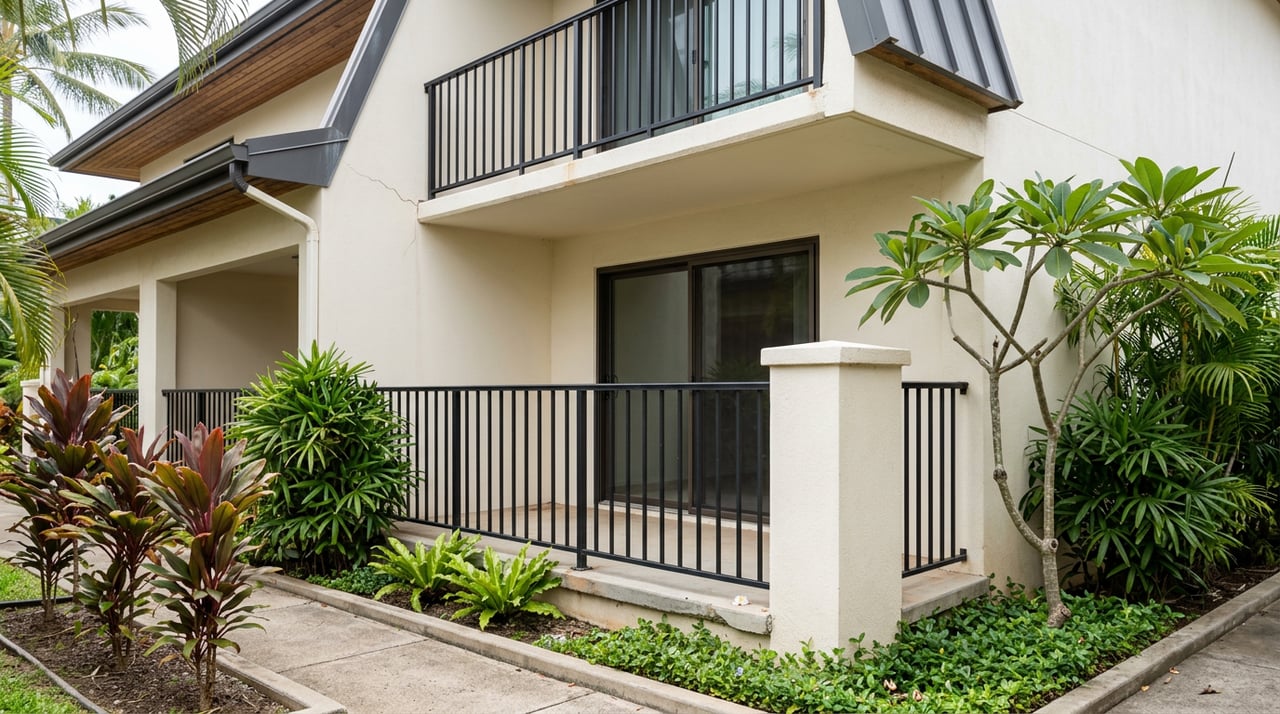
Owners at the Montage Residences in Kapalua found out the hard way what an insurance shortfall actually costs. When the building needed exterior repairs to correct stucco spalling, the association billed each owner $400,000. The affected buildings were closed for six months during construction, so owners kept paying full property taxes and full HOA dues on units they could neither live in nor rent.
That number reads like an outlier until you understand what actually happened to Hawaii's condo insurance market after the 2023 Lahaina wildfire, and why the same mechanics are now sitting quietly inside HOA dues up and down Wailea Alanui Drive. Two units in the same price bracket, same square footage, same view corridor, can carry very different real costs this year. The gap isn't in the list price. It's in the building's insurance file, and most of that file never makes it onto a listing sheet.
What actually broke after 2023
Before the wildfire, Hawaii condo associations paid roughly 8 to 9 cents in insurance cost per $100 of insured property value, according to state insurance officials briefing lawmakers this spring. After the fire, some buildings saw that figure spike past $1 per $100, more than a tenfold jump in a single renewal cycle.
The state's Department of Commerce and Consumer Affairs laid out the scale of it plainly in its March 2026 condominium bulletin: most associations saw renewal premiums increase between 150 percent and 800 percent compared to their expiring policies, with most landing around 400 to 500 percent. Some complexes now need more than fifteen separate insurance companies stacked together just to piece together full coverage, because no single admitted carrier will take on the whole risk.
Part of the reason is structural. The state's Department of Commerce and Consumer Affairs says admitted insurers in Hawaii typically cover only 20 to 30 percent of a building's hurricane exposure before pulling back, which forces associations into the surplus lines market for the rest. Surplus lines carriers aren't subject to the same rate oversight as admitted insurers, so that gap gets filled at whatever price the market will bear.
The reset, in three numbers
| Period | Insurance cost per $100 of value | What it meant on the ground |
|---|---|---|
| Before the 2023 wildfire | About 8 to 9 cents | Folded into monthly dues without much drama |
| Peak, post-wildfire | Over $1 (10x or more) | Renewal premiums up 150 to 800 percent, some buildings stacking 15+ carriers |
| As of an April 2026 legislative briefing | Roughly 20 to 30 cents | Still double or triple pre-fire levels, but moderating |
That middle row is the one that produced special assessments like the one at Montage. That bottom row is the one most buyers haven't priced in yet, because it's recent enough that it hasn't fully filtered down into how people talk about HOA fees.
Why this hits some Wailea buildings harder than others
Wailea's condo stock spans about fifty years of construction. Wailea Elua Village, the first condominium project built in the resort, completed its first phase in 1976, and it shares that original era of development with the other oceanfront communities that gave the corridor its reputation. Newer product sits at the other end of the timeline: Ho'olei, completed in 2008, and La'i Loa, currently under construction as the newest community in Wailea.
Age alone doesn't determine risk, but it correlates with the specific components state regulators have flagged as the ones now driving claims and premium increases: pipes, windows, concrete spalling, decks, and railings that have simply outlived their useful life.
That's why identical square footage at an identical price point can carry very different exposure depending on which building it sits in, and honestly, depending on which board has been running that building. A well-managed association with a fully funded reserve and a recent history of proactive repairs can look safer on paper than a newer building that deferred maintenance to keep dues low. The fee differences already show up at the high end of the market, where dues at some of Wailea's most elite oceanfront buildings, Wailea Point among them, have been reported exceeding $8,000 a month, largely because of how much of that number is insurance and reserves rather than landscaping and pool service.
The fix that's starting to show up in the numbers
Governor Green signed Act 296 in July 2025, reactivating the Hawaii Hurricane Relief Fund, which had sat dormant since the years following Hurricane Iniki. By spring 2026, state officials reported the fund had issued somewhere between 82 and 97 hurricane policies for condominium associations statewide, depending on which briefing you check, covering roughly $2.2 to $2.7 billion in insured value, and had contributed to more than $12 million in documented savings. A meaningful share of that savings came not from associations actually switching to the fund, but from boards using an HHRF quote as leverage to renegotiate with their existing private insurer.
Act 296 also created a loan program through the Hawaii Green Infrastructure Authority, letting associations borrow to fund the safety repairs and building upgrades that make them insurable again on normal terms. The catch is timing. Program officials have been clear that loans won't start disbursing for a year or two while projects clear engineering review, permitting, and contractor bidding, so this is a slow-moving fix rather than an immediate one.
Here's what that means for someone comparing two Wailea listings right now: an association that took a brutal renewal in 2024 may already be sitting on a materially better one in 2026, and that improvement will not show up in a portal's HOA fee field until well after the board has voted on it. The only way to see it is to ask.
What to actually ask for before you compare two listings on price
- The current reserve study and its percent funded, not just the headline number but the trend over the last few years
- The master policy's declarations page, specifically the deductible amounts for wind and hurricane
- A written history of special assessments over the past five years, including amounts and stated reasons
- Whether the association has applied for or received a Hawaii Hurricane Relief Fund quote, and what happened with it
- Whether the master policy is bare walls, walls-in, or all-in, since that determines what your personal HO-6 policy needs to cover
- Minutes from the last two board meetings where insurance renewal was discussed
None of this shows up in a portal search filter. It shows up in the condo document package, and it's the difference between comparing two units on price and comparing them on what they'll actually cost you to own.
A few questions before you write an offer
Does a special assessment follow the seller or the buyer? It depends on timing and how the purchase contract handles it. Buyers generally want any currently active assessment resolved by the seller before closing, and
Are older Wailea buildings automatically the riskier choice? Age is a factor, but management is a bigger one. A well-funded reserve and a board that has already tackled deferred maintenance can carry less real risk than a newer building that put off repairs to keep monthly dues looking attractive.
Will the Hurricane Relief Fund solve this for good? State officials describe it as a backstop and a negotiating tool, not a permanent fix. That means the due diligence above stays necessary on a building by building basis, even as the broader market improves.
The list price gets you in the door. The insurance file tells you what you're actually signing up for. If you're weighing two Wailea condos and want help pulling reserve studies, master policy language, and assessment history before you write an offer, that's exactly the kind of groundwork Steve Landin handles for buyers every day, along with the responsiveness Maui transactions demand when you're managing it all from off island. Every closed transaction also includes a $500 donation back into the Maui community, so working through these numbers together helps your new neighborhood too. Contact Steve to get started on your Maui home search.
This article is general information, not legal, tax or financial advice. Consult a qualified professional about your situation.